

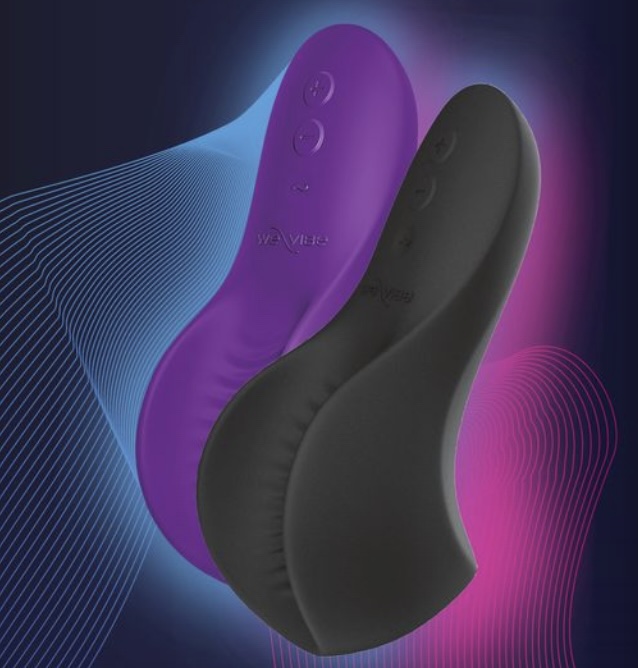
We-Vibe’s Shared Touch puts foreplay front and center, giving couples a new way to explore pleasure together and retailers a fresh story to tell consumers.
(Note: This Cover Story appears in the October 2026 issue of SE Magazine.)
For decades, the adult retail industry has been pretty good at selling couples the idea of more: more stimulation, more intensity, more toys, more ways to shake up the bedroom.
But what if the next big selling point isn’t more stuff? What if it’s more time?
We-Vibe’s Shared Touch is built around a deceptively simple proposition: What happens when couples stop rushing through foreplay and start treating it as an experience worth savoring?
The answer, according to We-Vibe, is a product designed to get both partners involved at the same time, and a conversation in your store that goes considerably beyond the “Here’s what this toy does” pitch.
“Shared Touch was not created to ‘fix’ something that is missing,” says Stephanie Ingram, Lovehoney Group’s B2B Marketing Manager, Americas. “It was designed to inspire exploration, playfulness and new ways for partners to connect.”
Ingram stresses that the distinction matters. Because when a customer walks into an adult store looking for a couples’ toy, they may not actually be shopping for a piece of technology.
For all it does well, the term “tech” doesn’t inherently raise anyone’s dopamine levels. What does, and what gets a customer’s blood flowing toward a sale, is knowing they’re shopping for an experience they hope will be more exciting, more connected or simply different from what they’ve been doing lately. Something more than the typical Saturday night Netflix-and-run-through-the-motions routine.
Shared Touch gives retail staff a way to start that conversation and help make that experience happen.
The case for more foreplay
The product arrives at a time when couples appear to be reconsidering just how much attention they give to the warm-up. According to 2026 research cited by We-Vibe, 40% of respondents said their foreplay typically lasts less than nine minutes, while 46% wished it lasted longer.
And longer foreplay wasn’t simply associated with more time on the clock. Among respondents who experienced longer-than-usual foreplay, 77% reported greater anticipation and excitement, 67% said they felt a stronger sensual connection and 60% said the overall sexual experience became more intense. Among those able to assess orgasm impact, 86.5% of women and 77.2% of men said longer foreplay improved it to some degree.
Perhaps most interesting from a retail perspective: 91% said longer foreplay made them feel more connected to their partner.
“Rather than asking couples to reinvent what already works, Shared Touch is designed to add to familiar routines by giving partners more ways to slow down, stay close and explore together,” Ingram says.
“The role of retail staff is to create a comfortable conversation, understand the couple’s goals and recommend products based on the experience they want to create.”
— Stephanie Ingram
Familiar feeling, new trick
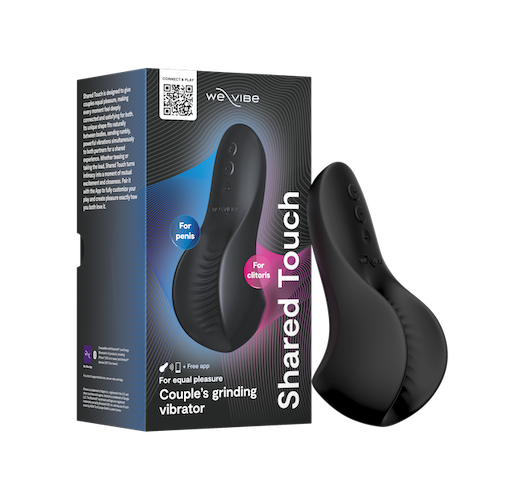
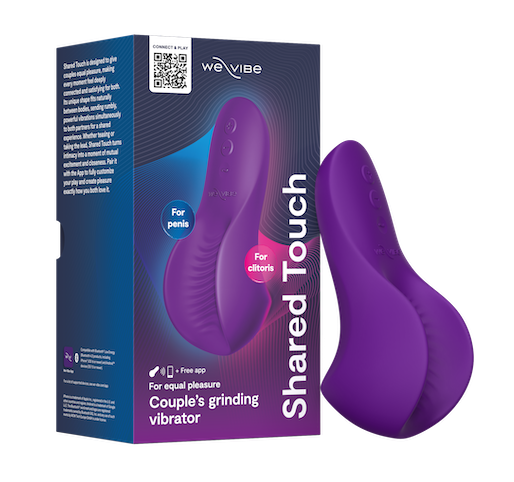
Shared Touch combines a gently ribbed stroker for the penis with a curved vibrating tip designed for clitoral stimulation. Its dual-sided design allows the product to sit between partners during close, body-to-body movement.
In other words, it’s designed for couples to experience together rather than one partner standing by waiting for a turn.
“Grinding is a familiar form of intimacy for many people, often discovered early in their sexual exploration, and Shared Touch allows couples to rediscover that experience in a new way,” Ingram says.
That familiarity is one of the product’s strongest retail advantages. For customers who may be nervous about couples’ toys, “Try something completely different” can sound like a tall order. “Try something that enhances something you already enjoy” is an easier sell.
The product’s ergonomic shape is designed to accommodate different positions and allow for body-to-body contact. It also features what We-Vibe describes as one of the most powerful motors in its portfolio, with strong, rumbly vibrations that can be felt through clothing.
The result is a product that can be introduced through sensation rather than specifications. And that is where sales staff come in.
Don’t sell the toy, sell the moment
One of the biggest mistakes retailers can make with couples’ products is getting trapped in the feature list. Yes, customers want to know what a product does. But features rarely close the sale by themselves.
“Customers often do not walk into a store knowing exactly what they want — they are looking for guidance,” Ingram explains. “The role of retail staff is to create a comfortable conversation, understand the couple’s goals and recommend products based on the experience they want to create, not just the specifications of the product.”
That means a sales associate might start with a question instead of a demonstration:
Are you looking for something you can use together rather than taking turns?
Or:
Have you tried a couples’ product before?
Those questions can quickly reveal whether Shared Touch is a good fit. The product is particularly suited to couples who are curious, open-minded and interested in experimenting together. It can also appeal to couples looking for alternatives to traditional intimacy, including those who cannot or choose not to engage in penetrative sex for personal, medical or other reasons.
That makes Shared Touch more than a specialty item. It gives retailers another option for customers who want partnered pleasure without relying on the same familiar script.
“Shared Touch was not created to ‘fix’ something that is missing. It was designed to inspire exploration, playfulness and new ways for partners to connect.”
— Stephanie Ingram
Make it visual
One of the challenges with innovative products is that consumers sometimes need to see the idea before they understand it. We-Vibe appears to have anticipated that.
The product’s distinctive design visually communicates that it is intended for two partners, with the penis stroker and clitoral stimulator providing obvious clues about its purpose.
“Consumer education was also a key consideration,” Ingram says.
The packaging includes imagery demonstrating the shared experience, while unboxing the Shared Touch provides anatomical illustrations showing different ways to position the product between two bodies. We-Vibe has also created the Shared Touch Foreplay Positions Playbook, a merchandising and education tool intended to help couples visualize how the product can be incorporated into familiar positions.
One example found in the playbook is “Mic Check,” which demonstrates how Shared Touch can be incorporated while couples explore different forms of oral stimulation and connection.
For retailers, that kind of merchandising support can be valuable because it turns an abstract concept into something customers can immediately understand. The playbook is available through distributors or Lovehoney Group account managers, giving retailers another tool to put the product into context.

Two people, one experience
There’s another piece of the Shared Touch story that retailers should emphasize: simultaneous participation. A couples’ toy can technically be a couples’ toy without creating much of a shared experience. One person controls it. One person wears it. One person receives the stimulation while the other participates indirectly.
Shared Touch takes a different approach.
“Both partners experience the same vibrations together — no one is simply watching or waiting,” Ingram says. “The experience is designed to be mutual.”
That idea of mutuality is central to the product’s appeal.
We-Vibe has explored shared sensation before. Its Chorus Pro, for example, uses a haptic squeeze remote that allows one partner to control intensity while feeling the response through the remote. Shared Touch brings that philosophy directly into the physical experience.
The dual-sided design, synchronized sensations and body-to-body positioning are intended to make vibration feel like something both partners are experiencing together.
“Shared Touch transforms vibration into something couples can experience together,” Ingram says.
For retailers, that gives the product a much stronger emotional hook than simply “dual stimulation.” It now becomes: You both get to feel it.
Foreplay is MORE play
Perhaps the strongest retail message surrounding Shared Touch can be summed up in four words: Foreplay is MORE play. That line shifts the conversation from solving a problem to creating an opportunity.
Customers don’t necessarily need to be convinced that something is missing from their relationship. They may simply need permission to have more fun with what already works.
Shared Touch is designed to encourage couples to explore positions, sensations and rhythms together. It can be used with a partner or independently, giving the product additional flexibility and making it a potentially approachable choice for couples who are new to incorporating toys into their relationship.
For retailers, that opens the door to a bigger conversation about what couples are really buying when they put a couples’ toy in their basket. They aren’t simply buying another vibrator or another bedroom accessory. They’re buying the possibility of doing something together that feels new, playful and connected.
“The purchase decision is not just about adding a product to the bedroom. It’s about creating a shared experience that encourages exploration, communication and intimacy,” Ingram says.
And that may ultimately be the strongest story a retailer can tell. Because the opportunity with Shared Touch isn’t simply to sell couples a new way to experience vibration. It’s to remind them that intimacy doesn’t have to be rushed, predictable or one-sided.
Sometimes the best way to turn up the heat is to slow things down and give both partners a reason to stay in the moment.
As Ingram puts it, “Shared Touch is about creating more opportunities for couples to play, explore and connect stronger by being together.”
For more information, please visit mail.wowtech.com/sharedtouch-amer.











You must be logged in to post a comment.